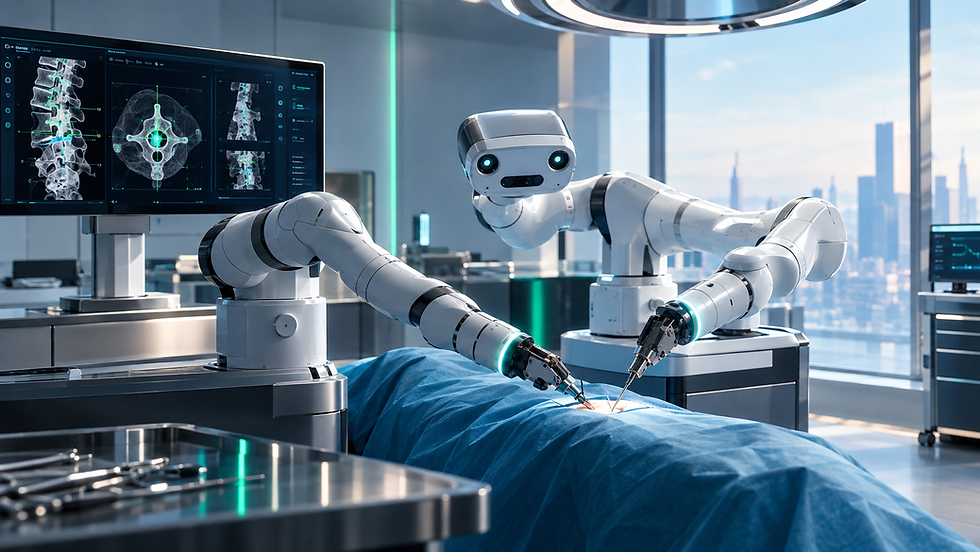
Inside the Surgical AI Brain: How an Autonomous Robot Makes Decisions
Updated: Aug 17

A scalpel never used to think.
It cut where a surgeon told it to cut.
That is beginning to change.
Modern surgical robots do more than hold instruments steady or filter hand tremor.
Some can observe the surgical field, interpret what they see, evaluate possible actions, and assist the surgeon with decisions.
Understanding that process is becoming an essential part of modern surgery.
Step 1. The robot sees
Every decision begins with perception.
High-definition cameras and sensors continuously capture information about the patient, the instruments, and the operating field.
Computer vision transforms those images into something the robot can understand.
Instead of pixels, it recognizes blood vessels, nerves, organs, tumors, and surgical instruments.
The operating field is updated continuously.
Every new image becomes part of the robot's understanding of the procedure.
Step 2. The robot thinks
Seeing isn't enough.
The robot must decide what to do next.
AI models combine the live surgical scene with knowledge learned from previous procedures.
They evaluate multiple possible actions.
Should the instrument move?
Should traction be reduced?
Is it safer to stop and ask the surgeon?
The goal isn't to find a perfect answer.
It's to identify the safest and most effective next step.
Step 3. The robot acts
Once a decision is made, the robot performs the requested movement.
Today's systems usually execute only specific tasks while remaining under surgeon supervision.
The surgeon stays in control.
The robot contributes speed, precision, and consistency.
Step 4. The robot learns from every movement
Every action changes the surgical field.
New images arrive.
Tissue moves.
Instrument positions change.
The AI immediately analyzes this new information and updates its next decision.
Perception.
Planning.
Action.
Feedback.
This cycle repeats throughout the procedure.
Why human oversight matters
Even the most advanced surgical AI cannot understand every clinical situation.
Unexpected anatomy, bleeding, or rare diseases still require human judgment.
A trustworthy system also recognizes uncertainty.
When confidence is low, the safest decision is often to pause and return control to the surgeon.
Knowing when not to act is part of intelligent decision-making.
The takeaway
Autonomous surgery isn't one decision.
It's thousands of small decisions made every second.
The robot sees.
The robot analyzes.
The robot acts.
The surgeon supervises.
As surgical AI continues to evolve, the future of the operating room will be built on collaboration between human expertise and machine intelligence—not one replacing the other.
Related reading