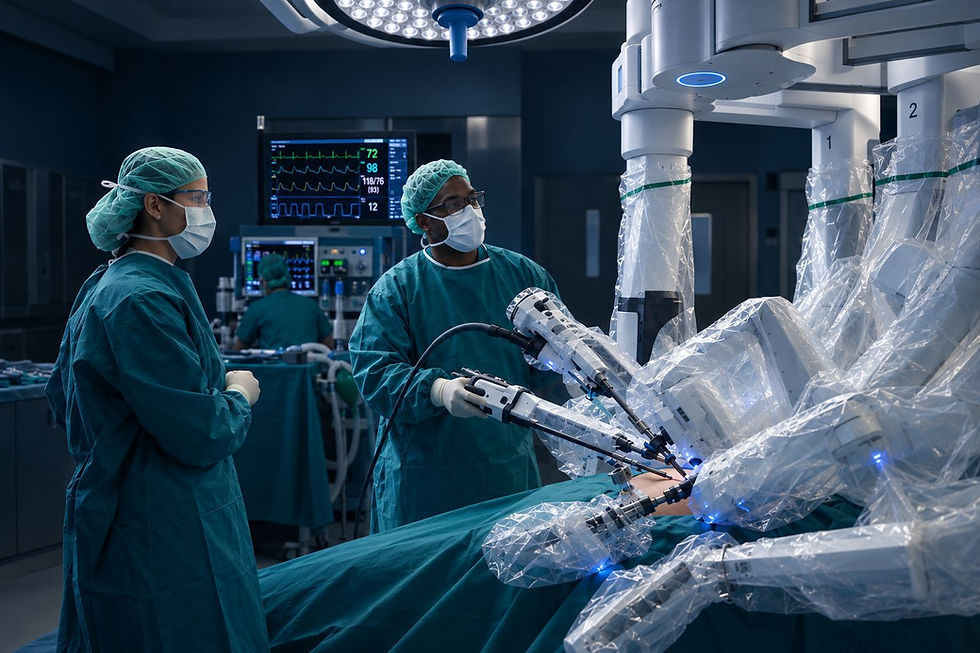
How Close Is Surgery to Becoming Autonomous?

Autonomous surgery is the idea that a robot could plan and perform part of an operation without a surgeon guiding its instruments.
The question matters because most headlines use the word “autonomous” for systems that differ widely.
A robot that holds a camera steady and a robot that clips an artery on its own are not the same thing, and the gap between them is the whole story.
The Short Answer
Surgery has reached autonomy for individual steps in laboratory and animal settings.
It has not reached autonomy for a complete operation on a patient.
On this site's six-level scale, the strongest research demonstrations sit around Level 3, where the robot carries out a task and a human supervises.
Levels 4 and 5, where a robot manages most or all of an operation, have not been demonstrated.
The full scale is explained on the Surgical Autonomy Ladder, and the interactive version maps real systems to each level.
What Has Been Demonstrated
The Smart Tissue Autonomous Robot, known as STAR, performed intestinal suturing on living pigs and was described by its authors as Level 3 autonomy.
That work showed an autonomous system could complete a delicate soft-tissue task inside a living animal.
In July 2025, a Johns Hopkins team published SRT-H in Science Robotics.
SRT-H is a robot that learned from surgical video paired with language instructions.
It completed the clipping-and-cutting step of a gallbladder removal on eight unseen gallbladders, finishing all 17 required tasks every time.
The robot corrected its own mistakes mid-procedure, and no human intervened.
The authors describe the result as step-level autonomy, which means one phase of an operation rather than the whole procedure.
The robot also took longer than a human surgeon to complete the work.
What Is Not Autonomous
Many recent surgical robot headlines describe systems that are controlled by a surgeon.
On July 8, 2026, a University of California San Diego team reported in Nature that teleoperated humanoid robots completed two gallbladder removals in pigs.
A surgeon operated those robots remotely, so the result shows hardware capability rather than autonomy.
It matters because it shows how quickly general-purpose robots are reaching the precision surgery requires, which is a prerequisite for autonomy rather than autonomy itself.
What Is in Operating Rooms Today
A 2024 systematic review in npj Digital Medicine examined 49 surgical robots cleared in the United States from 2015 to 2023.
Eighty-six percent of them sat at Level 1, meaning they assist a surgeon who stays in direct control.
Only 6 percent, three systems, reached Level 3.
None of the reviewed systems reached Levels 4 or 5.
The review searched its databases in December 2023, so systems cleared afterward are not counted.
The practical conclusion is that autonomy is advancing in research far faster than in clinical products.
Where the Evidence Stops
Every demonstration cited on this page used specimens, animal models, or controlled laboratory conditions.
A single step on eight gallbladders is encouraging, but it is a long way from the variety of anatomy, bleeding, and surprises in real patients.
No result cited here shows an autonomous robot managing a full operation from first incision to closure.
Evidence of safety and accountability when a robot makes a clinical decision is also still being built.
The Research Is Organizing Around the Goal
On October 12, 2026, Cedars-Sinai announced a Center for Autonomous Robotic Surgery.
The center is co-directed by Andrew Hung and Michael Yip, and it aims to build robots that perform certain tasks autonomously while working alongside surgeons.
Cedars-Sinai states that the systems are meant to support surgeons’ clinical judgment rather than replace it.
The announcement shows that autonomy is now a funded institutional goal, even though the clinical results are still ahead.
How to Read the Next Autonomy Headline
Four questions separate a real advance from a marketing claim.
Which level of autonomy does the demonstrated task reach, rather than the one the company claims?
Was the test performed on a specimen, an animal, or a patient?
Did the robot complete one step, or an entire procedure?
Did a human intervene during the run?
The Surgical Autonomy Ladder applies the same logic to every system it classifies.
Frequently Asked Questions
Has a robot performed autonomous surgery?
Robots have performed autonomous tasks in animals and autonomous steps on specimens, but the studies cited here do not show a fully autonomous operation on a patient.
Is a teleoperated robot autonomous?
No, because a surgeon controls every movement of the instruments.
What level of autonomy do operating room robots have?
Most reach Level 1, where the surgeon retains direct control.
Will robots replace surgeons?
The current research is designed around robots handling defined tasks under human supervision, and the leading centers describe their goal as supporting surgeons.
Detailed evidence on which systems claim what level is collected in The 2026 Surgical Technology Intelligence Report.
Related reading
Sources
Kim et al., “SRT-H: A hierarchical framework for autonomous surgery via language-conditioned imitation learning,” Science Robotics, July 9, 2025: https://doi.org/10.1126/scirobotics.adt5254
Johns Hopkins University, “Robot performs first realistic surgery without human help,” July 9, 2025: https://hub.jhu.edu/2025/07/09/robot-performs-first-realistic-surgery-without-human-help
Saeidi et al., “Breaking Barriers in Robotic Soft Tissue Surgery: Conditional Autonomous Intestinal Anastomosis” (STAR, preprint): https://arxiv.org/pdf/2107.01288
Liang et al., “In vivo feasibility study of humanoid robots in surgery,” Nature, July 8, 2026: https://doi.org/10.1038/s41586-026-10796-x
Lee et al., “Levels of autonomy in FDA-cleared surgical robots: a systematic review,” npj Digital Medicine, April 26, 2024: https://www.nature.com/articles/s41746-024-01102-y
Cedars-Sinai, “Cedars-Sinai Establishes Center for Autonomous Robotic Surgery,” October 12, 2026: https://www.cedars-sinai.org/newsroom/cedars-sinai-establishes-center-for-autonomous-robotic-surgery/