Artificial Intelligence in Surgery: A Practical Guide
Updated: Aug 17
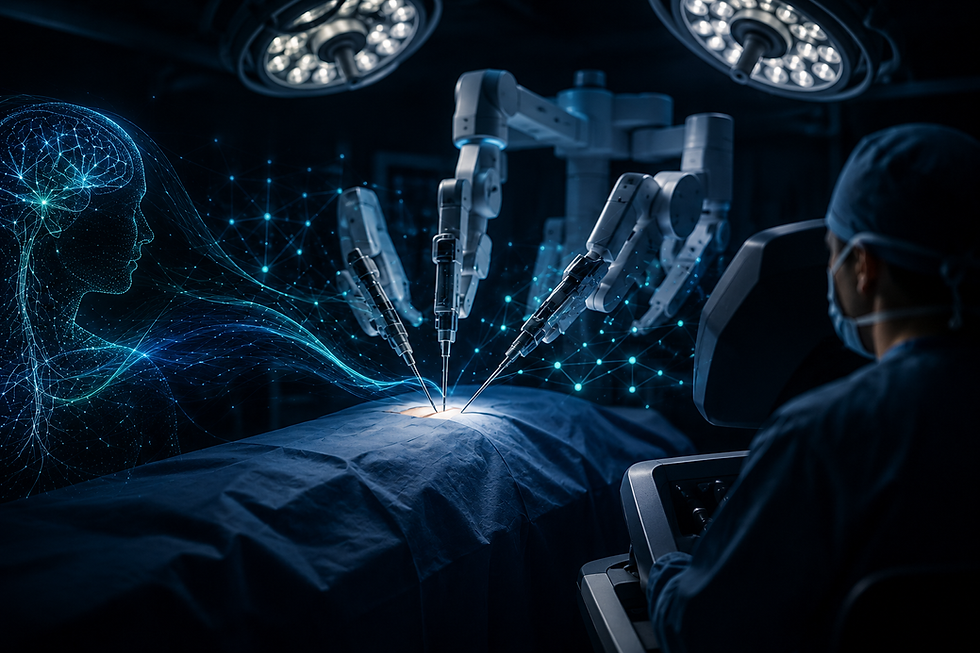
Artificial intelligence is becoming part of modern surgical care.
It analyzes medical images.
It recognizes anatomy during an operation.
It predicts complications.
It supports robotic surgery.
These technologies are often grouped as "AI in surgery."
That broad label hides important differences.
Understanding the main categories makes it easier to evaluate new research, products, and clinical applications.
The five categories of surgical AI
Most applications of artificial intelligence in surgery fall into five broad categories.
Each solves a different problem.
1. Diagnostic AI
Diagnostic AI helps detect disease before surgery.
These systems analyze medical images, pathology slides, laboratory results, or clinical data to identify abnormalities that may be difficult to recognize.
Their role is to support clinical decision-making.
The final diagnosis always remains the responsibility of the healthcare team.
Examples include detecting tumors on CT scans, identifying fractures on X-rays, or recognizing patterns associated with specific diseases.
2. Computer vision
Computer vision allows AI to understand what is happening during an operation.
Instead of seeing pixels, the system identifies anatomy, surgical instruments, tissue planes, and important structures.
Some systems can recognize different stages of an operation or alert the surgeon when critical anatomy is nearby.
Computer vision is becoming an important component of robotic surgery and surgical navigation.
3. Predictive AI
Predictive AI estimates what is likely to happen before or after surgery.
These models analyze patient characteristics, laboratory results, imaging, and operative data to estimate the risk of complications, readmissions, prolonged hospital stays, and other outcomes.
The goal is to support better planning and closer monitoring of higher-risk patients.
4. Autonomous systems
Some AI systems move beyond analysis and perform specific surgical tasks.
Current research focuses on narrowly defined actions performed under surgeon supervision.
Examples include automated suturing, camera control, and other predefined movements.
Most commercial robotic systems remain surgeon-controlled.
Higher levels of surgical autonomy are still being actively researched.
5. Haptic intelligence
Open surgery allows surgeons to feel tissue directly.
Robotic surgery reduces that natural sense of touch.
Haptic systems use sensors and artificial intelligence to estimate tissue resistance and instrument forces.
This additional information can improve precision during delicate procedures and reduce unnecessary tissue injury.
How to interpret new AI announcements
Most surgical AI systems either provide information or perform a specific task.
That distinction is useful when evaluating new technologies.
Some systems analyze data and support clinical decisions.
Others control part of a surgical workflow under supervision.
The level of responsibility determines how the technology is validated, regulated, and introduced into clinical practice.
It is also helpful to ask where the system operates.
Some AI tools assist before surgery.
Others work during the procedure.
Some support postoperative care.
Knowing where the technology fits provides important context.
Why understanding the categories matters
Artificial intelligence is not replacing surgery.
It is becoming part of every stage of surgical care.
A patient may benefit from diagnostic AI before an operation, computer vision during the procedure, and predictive AI after surgery.
Each technology contributes differently.
Understanding these categories makes it easier to evaluate new developments and understand where they fit within the surgical pathway.
Key takeaways
Artificial intelligence in surgery includes several different technologies.
Diagnostic AI supports disease detection and clinical decision-making.
Computer vision analyzes anatomy and the surgical field in real time.
Predictive AI estimates the risk of complications and other outcomes.
Autonomous systems and haptic technologies expand the capabilities of robotic surgery.
Most hospitals will use multiple forms of AI across the surgical pathway.


