LEM Surgical Calls Dynamis a "Surgical Humanoid." The FDA Calls It a Stereotaxic Instrument.
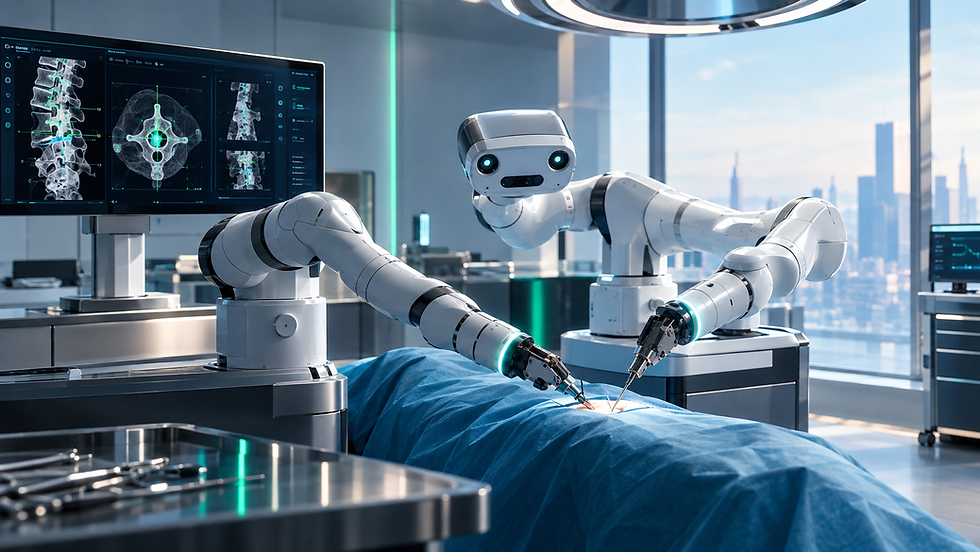
LEM Surgical says it invented a new category of medical device.
The company calls its Dynamis Robotic Surgical System the world's first "surgical humanoid," built to mimic the bimanual dexterity of a human surgeon.
The FDA's clearance letter doesn't use that term anywhere.
It classifies Dynamis under 21 CFR 882.4560, Regulation Name "Stereotaxic Instrument," the same regulation and the same product code as its 2017 predicate device.
What the FDA actually cleared
The clearance, K243326, dated April 23, 2025, covers a navigation-based robotic platform for spine surgery.
The system description in LEM's own 510(k) summary lists two computer-controlled robotic arms for surgical guidance and a third arm that holds the optical navigation camera.
Its indications for use are narrow: helping a surgeon locate anatomy and position an instrument guide, specifically for placing non-cervical spinal pedicle screws.
The predicate device LEM compares itself to Globus Medical's Excelsius GPS, a navigation robot on the market since 2017.
The surgeon still moves the arm
The 510(k) summary describes the system's control method directly: force-controlled movement via a foot pedal or a squeeze bracelet called the Dynacuff.
That means the surgeon's own physical input drives the robotic arm's motion.
Nothing in the clearance document describes the system generating its own surgical plan or executing a task without that continuous input.
On the same six-level scale used to build the Surgical Autonomy Ladder, that places Dynamis at Level 1: continuous surgeon control, not independent action.
Where other cleared systems sit on that same scale is what the Surgical Autonomy Ladder tracks.
A second clearance, six months later
LEM Surgical announced a second FDA 510(k) clearance for Dynamis on June 23, 2026.
The new clearance adds simultaneous bilateral tracking of multiple vertebrae and extends the system's indications to include cervical procedures, which the original clearance excluded.
CEO Yossi Bar described one arm stabilizing a spinal segment while the second arm executes the intervention, calling it an "upper torso humanoid design."
That description covers tracking and positioning capability. It does not describe the robot deciding what to do next on its own.
The autonomy roadmap is a roadmap, not a clearance
At CES on January 5, 2026, LEM Surgical announced a plan to integrate NVIDIA Jetson Thor, NVIDIA Isaac for Healthcare, and NVIDIA Cosmos into future versions of Dynamis, aiming for what the company called "unprecedented levels of autonomy."
The same press release includes a forward-looking statements disclaimer stating plainly that these future capabilities have not yet received FDA clearance.
Everything Dynamis is cleared to do today, it does under a surgeon's continuous physical control. Everything NVIDIA-branded and autonomy-related is still on a roadmap, not a 510(k) summary.
Two documents, two vocabularies
A press release can call a device whatever category it wants.
A 510(k) clearance can't; it has to match an existing regulation.
Dynamis is a real, FDA-cleared, commercially used spine robot with a growing set of capabilities. None of that requires the word "humanoid" to be true.
The word is doing marketing work the regulatory filing doesn't.


