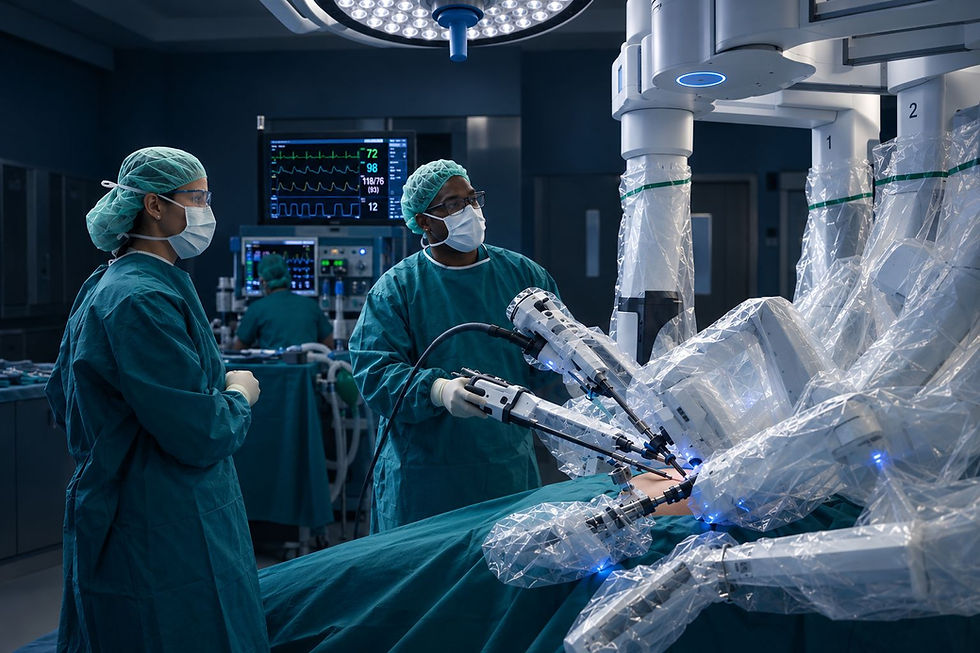
How NVIDIA Is Training Surgical Robots Before They Reach Patients
Updated: Oct 6

NVIDIA does not build surgical robots.
It builds the simulation layer that a growing list of companies that do build surgical robots now train on before those robots reach a patient.
CMR Surgical, Johnson & Johnson MedTech, Medtronic, and LEM Surgical have all named NVIDIA infrastructure in official announcements dated January 5 and March 16, 2026.
None of them are using it to replace a surgeon.
All of them are using it to compress the distance between a system that works in a lab and a system that works in an operating room.
The stack, not the scalpel
NVIDIA's surgical offering sits underneath the robot, not inside the procedure.
Cosmos-H is a healthcare-specific version of NVIDIA's Cosmos world model, built to generate physics-based synthetic surgical data for training and validating robotic policies in simulation.
Isaac for Healthcare is the simulation and workflow layer that runs on top of it.
Jetson AGX Thor and IGX Thor are the compute hardware that eventually carries a trained model into the physical device, whether that's a surgical cart or an autonomous arm.
None of these products make a clinical decision.
They generate the training data and the simulated environments a robot's AI is validated against before anyone tries it on a person.
Four systems, four different uses
CMR Surgical is using Cosmos-H simulation to train and validate robotic intelligence for its Versius surgical system before clinical deployment, according to NVIDIA's GTC announcement.
Johnson & Johnson MedTech is using Isaac Sim- and Cosmos-based post-training workflows to train and validate systems for the Monarch Platform for Urology, the same announcement states.
Medtronic is exploring NVIDIA IGX Thor to deliver functional safety in its surgical robotic systems, a more tentative use than the other three.
Source: NVIDIA Investor Relations
LEM Surgical is further along on paper.
Its Dynamis system, described by the company as a "surgical humanoid," uses NVIDIA Isaac for Healthcare and Cosmos Transfer to train its autonomous arms, running on Jetson AGX Thor and NVIDIA Holoscan.
XRlabs is using the same Thor and Isaac for Healthcare stack to build exoscopes that guide surgeons with real-time AI analysis.
Source: NVIDIA Newsroom
Simulation isn't clearance
Every claim above comes from a company press release, not a peer-reviewed study or an FDA filing naming NVIDIA's role. That distinction matters more here than in most robotics stories.
Training a robotic policy in simulation is a real, useful step. It happens well before a device sees a patient, and it says nothing on its own about how the finished system performs in one.
"Surgical humanoid" is LEM Surgical's own description of Dynamis, not an independently verified classification. "Exploring" is NVIDIA's own word for what Medtronic is doing with IGX Thor, not a confirmed integration.
None of this appears yet in the FDA's device databases or in a published clinical study, which is where a system's actual autonomy level gets tested against a live patient rather than a simulated one.
Where each of these systems actually sits on a verified scale is what the Surgical Autonomy Ladder tracks.
The layer beneath the leaderboard
Surgical robotics coverage tends to rank companies by whose robot is smartest.
That's the wrong question right now.
The more useful question is which OEMs are quietly standardizing on the same underlying simulation infrastructure, because that infrastructure is what will make the next wave of autonomy claims easier to build and harder to independently check.
NVIDIA is becoming the answer to that question for a widening share of the surgical robotics industry, one training partnership at a time.
The sourced claims for Versius and Monarch are listed in the Surgical AI & Robotics Database.