The Surgical Autonomy Ladder: What Levels 0 Through 5 Actually Mean
Updated: 1 hour ago

Surgical robots are often called autonomous, yet the word covers very different amounts of independence.
The Surgical Autonomy Ladder is a six step scale that shows how much of an operation the robot decides and performs instead of the surgeon.
It runs from Level 0, where the surgeon does everything through the machine, to Level 5, where a robot would perform an entire operation alone.
Placing a system on the ladder is the fastest way to judge what an autonomy claim actually means.
What the ladder measures
The scale was proposed in 2017 by Yang and colleagues, an international group of robotics researchers and surgeons writing in Science Robotics.
It follows the same logic as the levels used to describe self driving cars.
Each level answers two questions: who decides what to do, and who moves the instrument.
The scale describes the division of work between surgeon and robot, and it does not measure how good or safe a system is.
Source: Science Robotics
The six levels at a glance
Level | Name | Who decides | Who controls the instrument | Human supervision | Examples | Status |
0 | No autonomy | Surgeon | Surgeon, through a console | Continuous | da Vinci (original framework) | Widely used in operating rooms |
1 | Robot assistance | Surgeon | Surgeon, with robot guidance | Continuous | 42 of 49 FDA-cleared robots in the 2015–2023 review | Cleared and in use |
2 | Task autonomy | Surgeon chooses the task and settings | Robot, for that task | Surgeon starts and monitors each task | 4 FDA-cleared systems; ARISE (research) | Cleared in a few specialties |
3 | Conditional autonomy | Robot proposes, surgeon approves | Robot, after approval | Surgeon approves plans and can intervene | TSolution One and 2 other cleared systems; STAR laparoscopic (research) | 3 cleared systems; soft-tissue surgery demonstrated in pigs only |
4 | High autonomy | Robot chooses the plan, surgeon approves it | Robot | Surgeon supervises and can step in | None in the 2015–2023 review; SRT-H (research, one phase) | Research only; ex vivo |
5 | Full autonomy | Robot | Robot | Optional | None documented | Not demonstrated |
Download the complete Surgical Autonomy Ladder guide (PDF)
Level 0: Manual
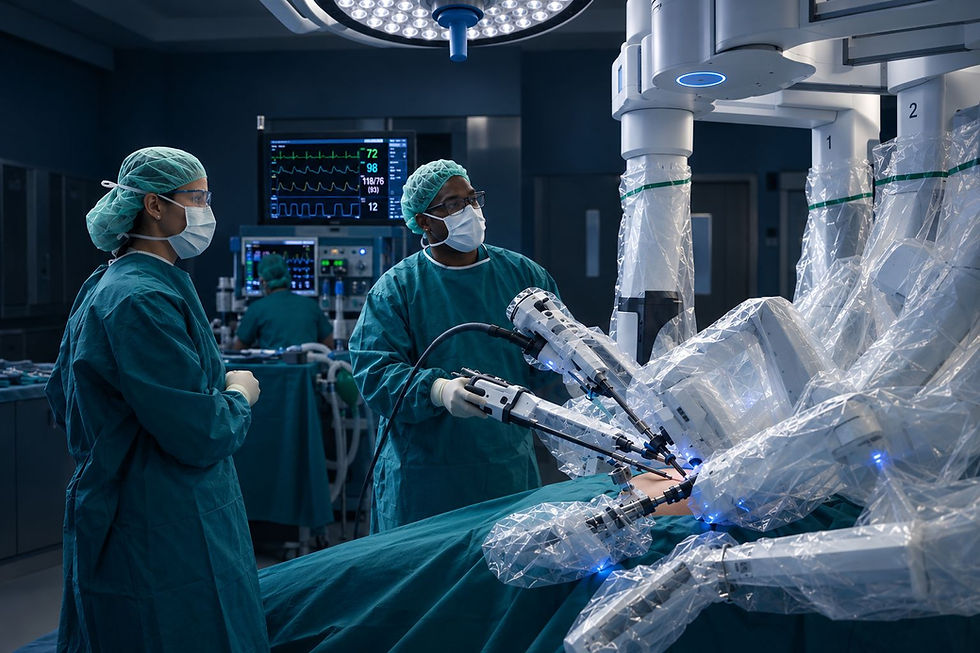
The robot does exactly what the surgeon commands and nothing more.
The surgeon makes every decision and controls every movement, so supervision is continuous.
Motion scaling still counts as Level 0 in the original framework, because the robot's output is the surgeon's own intended motion.
The da Vinci system, where the surgeon moves the instruments through a console, is the standard example.
Source: Journal of Visceral Surgery
Level 1: Assisted
The robot helps, but the surgeon stays in continuous control.
The surgeon still makes every decision and moves the instruments.
The robot adds guidance such as motion limits, haptic feedback, tremor filtering or tool tracking.
Most FDA cleared surgical robots sit here, as the count above shows.
Source: Intuitive Surgical
Level 2: Shared Control
The robot carries out a specific task on its own once the surgeon starts it.
The surgeon chooses the task and supplies the settings, because the robot does not create its own plan.
The robot controls the instrument for the length of that task, while the surgeon starts and watches it.
The research example is ARISE, an autonomous system for intraocular surgery from the Institute of Automation, Chinese Academy of Sciences.
A Science Robotics paper published on January 14, 2026 reports that it achieved targeted retinal injections throughout the intraocular space.
One defined task performed by the robot fits the definition of Level 2.
Source: Stryker
Level 3: Supervised Autonomy
The robot proposes the plan and the surgeon approves it.
The robot builds patient specific strategies from scans and live imaging, and the surgeon selects or revises one.
After approval the robot executes and monitors the plan, while the surgeon watches and can intervene.
The leading research example is the laparoscopic Smart Tissue Autonomous Robot, known as STAR, from Johns Hopkins and Children's National Hospital.
It sews two ends of small bowel together, generates suture plans, lets the operator choose one, and tracks the tissue as the animal breathes.
The authors classified it as Level 3 of 5.
It was tested on phantom tissue and in four pigs, which were monitored for one week.
The in vivo procedure took about 62 minutes, compared with 25.6 minutes for a single manual laparoscopic control.
About 66 percent of stitches in the pigs were placed correctly on the first attempt, and the operator corrected the rest.
Source: Science Robotics
Level 4: Conditional Autonomy
The robot chooses a plan and carries it out while the surgeon supervises.
The surgeon approves the plan, watches the operation and can step in.
Yang and colleagues compared this level to a robotic resident operating under an attending surgeon.
No FDA cleared system reached Level 4 in the review covering 2015 to 2023.
The closest research demonstration is SRT-H from Johns Hopkins, which performed the clipping and cutting phase of gallbladder removal on eight ex vivo gallbladders with no human intervention.
A high level planner issued task instructions and corrections, and a low level policy generated the instrument movements.
The authors describe the result as step level autonomy, which means one phase of one operation and not a full procedure.
The work used ex vivo tissue, so no patient was involved.
Source: Science Robotics
Level 5: Full Autonomy
The robot performs an entire operation without a surgeon.
It makes every decision and controls every instrument, including the planning that happens before surgery.
Human supervision is optional, and the system would have to handle unexpected events without asking for help.
Yang and colleagues described it as a robotic surgeon able to perform the procedures of a general surgeon.
No system at this level is documented in the sources cited on this page.
Download the complete Surgical Autonomy Ladder guide (PDF)
Where the ladders disagree
Two respected versions of the scale place the same robot on different levels.
Yang and colleagues place teleoperated robots, including systems that only scale the surgeon's motion, at Level 0.
The FDA review places teleoperation at Level 1 and reserves Level 0 for devices with no robotic component.
As a result, da Vinci appears at Level 0 in one framework and Level 1 in the other.
Any autonomy claim should therefore name the framework it uses.
How to read an autonomy claim
Four questions turn a headline into a level.
Which task or step is autonomous, and which parts still belong to the surgeon?
Who approves the plan, and who can stop the robot?
Where was it tested: phantom, ex vivo tissue, animals or patients?
Did an independent study or a regulatory filing back the claim, or only the company?
A robot that performs one step on ex vivo tissue sits far from a robot that performs an operation in patients, even when both are called autonomous.
Where FDA cleared robots sit

A systematic review of every FDA cleared surgical robot from 2015 to 2023 sorted 49 systems onto the ladder.
Forty two systems (86 percent) sat at Level 1, four (8 percent) at Level 2, and three (6 percent) at Level 3.
None reached Level 4 or Level 5.
The review searched the FDA databases in December 2023, so later clearances are not counted.
The three Level 3 systems targeted bone milling in orthopedic surgery, prostate biopsy in urology, and hair follicle extraction in plastic surgery.
One of them, TSolution One, builds a patient specific plan and mills bone automatically while the surgeon watches.
Level 2 systems appeared only in orthopedic surgery, urology, general surgery, gynecology and interventional radiology.
Only 19 of the 49 systems (39 percent) came with clinical testing data, including all three Level 3 systems.
Source: npj Digital Medicine
Go deeper
The Surgical Autonomy Registry places nine surgical robots on the six level ladder against FDA filings and peer reviewed studies.
The Autonomy Claims Report examines how autonomy claims hold up against primary evidence.
Frequently asked questions
What are the six levels of surgical autonomy?
The levels are 0 no autonomy, 1 robot assistance, 2 task autonomy, 3 conditional autonomy, 4 high autonomy, and 5 full autonomy.
The higher the level, the more the robot decides and the less the surgeon does.
Who created the surgical autonomy scale?
Yang and colleagues proposed it in Science Robotics in 2017.
Later work, including a 2024 review of FDA cleared robots, adapted it to surgery.
What level is the da Vinci?
It is Level 0 under the original framework and Level 1 under the FDA review scale.
The surgeon controls every movement in both.
Are there Level 4 or Level 5 surgical robots?
None appeared among FDA cleared robots in the review covering 2015 to 2023.
The sources cited on this page document no Level 5 system, and the closest Level 4 research example operated on ex vivo tissue.
Has autonomy been used on human patients?
Yes, at Levels 2 and 3, in cleared systems for bone milling, prostate biopsy and hair follicle extraction.
The soft tissue autonomy results cited on this page come from pigs and ex vivo tissue.
Does the FDA classify surgical robots by autonomy level?
The review states that the FDA regulates all surgical robots as Class II devices.
It also states that the FDA has advocated the term robotically assisted surgical devices since 2015, to emphasize that cleared systems have no robotic autonomy.
The review notes speculation that future Level 4 and Level 5 systems could be Class III devices requiring premarket approval.
Does a higher level mean a safer or better robot?
No, because the ladder describes who does the work and not how well it is done.
The review's authors note that risk depends on the procedure, and that levels do not capture it.
How can an autonomy claim be checked?
Ask which task is autonomous, who approves the plan, where it was tested, and whether independent evidence exists.
The Surgical Autonomy Registry applies this approach to nine named robots.
Readers who want the full sourced picture across regulation, companies, and evidence can find it in The 2026 Surgical Technology Intelligence Report.