Autonomous Surgery: The 2026 Landscape
- 2 hours ago
- 7 min read

Ask a surgeon what changes when a robot takes on part of a procedure, and most will not start with the mechanics.
They start with trust.
How much of the task can genuinely be handed off. How much control has to stay in human hands, regardless of what the system claims it can do.
That question is becoming harder to answer with intuition alone.
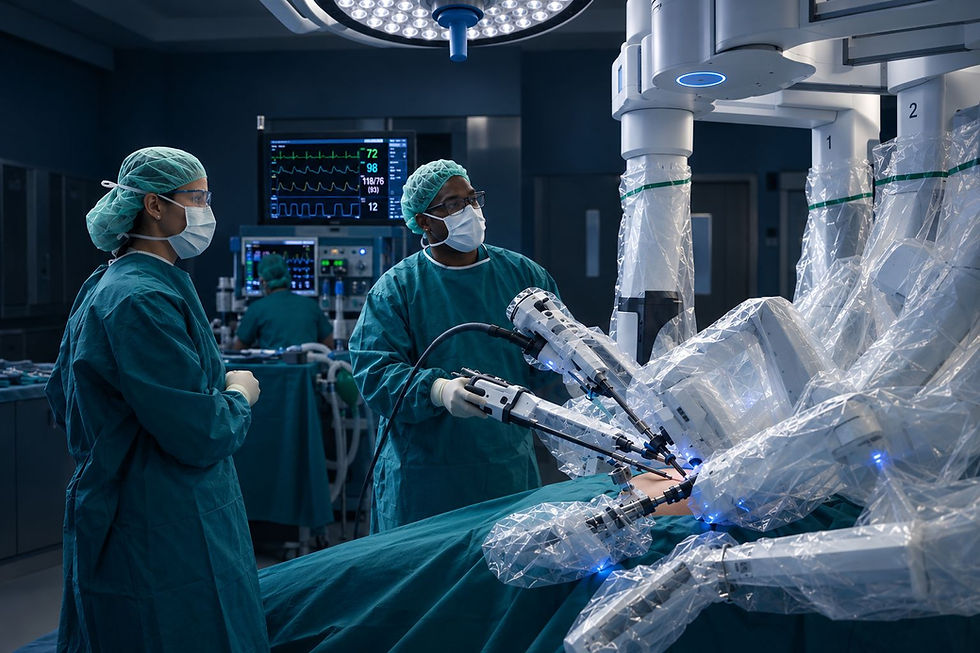
Surgical robots are no longer simple instrument extensions. They are beginning to see, interpret, and, in narrow, defined ways, decide.
The distance between a robot that mirrors a surgeon's hand movements and one that executes a step on its own is not a small technical gap. It is the difference between assistance and autonomy. Surgeons are the ones who have to know exactly where that line sits, procedure by procedure, system by system.
The shift is that these technologies are no longer developing independently.
They are becoming a stack.
At the bottom are sensors and surgical data. Above them sit perception, decision-making, and motion planning. At the top is the surgical robot itself, operating under increasingly sophisticated levels of human supervision.
That stack is the foundation of autonomous surgery.
What autonomous surgery actually means
Autonomous surgery refers to a surgical system performing one or more parts of a procedure with limited or no continuous human control.
That definition matters because autonomy is not binary.
A robot that follows a surgeon's movements is not autonomous.
A robot that performs a predefined surgical maneuver while the surgeon supervises it is operating at a different level.
A system capable of planning and adapting its actions to changing anatomy represents a much larger technological step.
A useful framework is the Surgical AI Autonomy Ladder:
Level | Description | Human role |
0 | Manual surgery | Surgeon performs the procedure |
1 | Robotic assistance | Robot assists specific actions |
2 | Shared control | Surgeon and robot jointly control movement |
3 | Supervised autonomy | Robot performs defined surgical tasks under continuous human supervision |
4 | Conditional autonomy | Robot manages broader surgical workflows within predefined conditions; human intervenes when required |
5 | Full autonomy | System performs the surgery independently |
Most real-world surgical robotics remains concentrated at the lower levels.
The frontier is moving toward Level 3, where robots can execute increasingly complex, well-defined surgical tasks under human supervision.
The technology stack
Autonomous surgery requires much more than a robotic arm.
1. Surgical data
Every autonomous system needs examples of what surgery looks like. That means enormous quantities of:
surgical video
instrument trajectories
force and tactile information
anatomical images
surgical actions
procedural outcomes
surgeon demonstrations
Data is becoming one of the most important strategic assets in surgical robotics.
The challenge is that surgical data is difficult to collect, standardize, and label.
Unlike autonomous driving, there is no equivalent of millions of standardized miles of publicly available surgical footage. That makes high-quality datasets a bottleneck.
2. Computer vision
A robot cannot autonomously manipulate anatomy if it cannot reliably understand what it is looking at. Computer vision systems are being developed to identify:
anatomical structures
surgical instruments
tissue boundaries
bleeding
surgical phases
anatomical changes
the consequences of previous actions
This is one of the fundamental differences between conventional robotic surgery and autonomous surgery.
A conventional surgical robot can precisely move an instrument. The autonomous robot needs to understand where that instrument is, what it is touching, and what should happen next.
3. Surgical intelligence
Perception alone is not enough. The system also needs to determine what action should follow.
This introduces machine-learning models capable of learning surgical workflows and predicting the next appropriate action.
The long-term objective is something closer to a closed loop:
See → Understand → Plan → Act → Observe → Adapt
That loop is the core of autonomous surgery.
4. Motion planning and control
Once a system decides what it wants to do, it needs to translate that decision into physical movement. This is where robotics becomes critical.
The system must account for instrument position, tissue deformation, collisions, anatomical constraints, force, uncertainty, and surgical objectives.
The difficulty is that the human body is not a rigid environment.
Tissue moves. It deforms. It bleeds.
Anatomy varies from patient to patient.
An autonomous surgical robot therefore has to operate in one of the most unpredictable environments in robotics.
Who is building autonomous surgery?
The field is developing across several different groups rather than being controlled by a single company.
Established surgical-robotics companies
Large surgical robotics companies already possess something extremely valuable: installed robotic systems and access to surgical workflows.
Companies such as Intuitive Surgical, Medtronic and Johnson & Johnson are building increasingly sophisticated robotic platforms.
Their near-term opportunity is not necessarily full autonomy. It is the gradual introduction of more intelligent assistance, computer vision, workflow awareness and task automation.
Research laboratories
Some of the most important autonomy breakthroughs are coming from academic research.
Researchers are experimenting with robots that can perform increasingly sophisticated tasks such as tissue manipulation, suturing, cutting, anatomical localization and surgical navigation.
One important direction is learning from demonstration.
Instead of programming every movement manually, researchers train systems using demonstrations from expert surgeons. The robot learns patterns of surgical behavior from data.
AI and robotics companies
A second group is emerging around the intelligence layer itself.
These companies are focused less on building another robotic arm and more on developing surgical foundation models, computer vision, autonomy software, simulation, data infrastructure, and robotic control systems.
This could become increasingly important as physical robotic platforms become standardized.
The future surgical robotics market may therefore separate into two layers: the machine, and the intelligence that controls it.
The missing infrastructure
One of the biggest misconceptions about autonomous surgery is that the final challenge is simply building a better robot.
It isn't.
The missing infrastructure is much broader. An autonomous surgical system needs somewhere to learn, test, and validate its behavior before touching a patient. That creates a new category of infrastructure.
Surgical simulation. Robots need virtual and physical environments where they can practice procedures repeatedly.
Surgical datasets. Models need enormous amounts of high-quality surgical data.
Digital twins. Patient anatomy and surgical environments increasingly need to be represented computationally.
Safety systems. An autonomous robot needs mechanisms for detecting uncertainty and stopping before an unsafe action.
Validation. Developers need objective ways to demonstrate that an autonomous system performs reliably.
This is why autonomous surgery increasingly resembles autonomous driving.
The robot is only one component. The larger challenge is building the validation infrastructure around it.
Why autonomy is arriving slowly
There is a fundamental difference between autonomous surgery and many other forms of robotics.
A robot operating in a warehouse can drop a box. A surgical robot can injure a patient.
That changes the engineering requirements completely.
An autonomous surgical system must deal with:
Anatomical variability. Every patient is different.
Incomplete information. The robot cannot always see or understand everything relevant.
Dynamic environments. Tissue moves and changes during the procedure.
Rare events. The most dangerous situations may be precisely the situations for which the system has the least training data.
For these reasons, the path toward autonomy is likely to be incremental.
The likely path to autonomous surgery
The first autonomous systems are unlikely to perform entire operations.
They will perform tasks.
A robot might autonomously position an instrument, maintain camera orientation, track anatomy, manipulate tissue, perform a specific suturing sequence, or execute a predefined dissection step.
The surgeon remains responsible for the operation.
Over time, multiple autonomous tasks can potentially be connected.
Task autonomy → procedural autonomy → broader surgical autonomy
That is a much more realistic trajectory than jumping directly from conventional surgical robots to a fully autonomous operating room.
Where the industry stands in 2026
The industry is entering what could be called the supervised autonomy era.
Robots are becoming increasingly capable of performing constrained tasks. AI systems are becoming better at interpreting surgical video. Simulation is becoming more sophisticated. Surgical datasets are expanding. Compute is moving closer to the operating environment.
But full autonomous surgery remains a long-term objective rather than a clinical reality.
The most important developments therefore are not necessarily the robots that look the most futuristic. They are the systems quietly solving the infrastructure problems underneath them.
The 2026 autonomous surgery stack
The emerging ecosystem can be simplified into seven layers.
01 — Data. Surgical video, sensor data, demonstrations, and outcomes.
02 — Perception. Computer vision and anatomical understanding.
03 — Intelligence. Models that understand surgical context and predict actions.
04 — Planning. Determining what the robot should do next.
05 — Control. Converting decisions into precise physical movements.
06 — Safety. Monitoring uncertainty, detecting failure, and maintaining human oversight.
07 — Validation. Simulation, testing, and clinical evidence.
The robotic arm sits inside this stack. It is not the entire stack.
Developments worth tracking
A handful of developments will shape how quickly autonomous surgery advances beyond the task level.
1. More capable surgical datasets. The organizations that can collect, structure, and use high-quality surgical data will have a major advantage.
2. Surgical foundation models. AI models capable of understanding surgical video, instruments, anatomy, and workflow could become the intelligence layer for future robots.
3. Task-level autonomy. The first commercially meaningful autonomous capabilities are likely to appear at the task level rather than the procedure level.
4. Simulation and validation. The ability to test autonomous systems before clinical deployment could become as important as the robot itself.
5. Interoperability. As data and platforms multiply across vendors, systems that can share surgical data and workflows across institutions will compound their advantage over closed, single-vendor ecosystems.
The real race
The autonomous-surgery race is often described as a competition between surgical-robotics companies.
That is only part of the story.
The deeper competition is over who can build the complete learning and validation loop. A winning system will need:
Data → AI → simulation → planning → robotics → safety → clinical validation → more data
The companies capable of closing that loop may ultimately have a greater advantage than companies that simply build the most sophisticated mechanical robot.
Why it matters
Autonomous surgery will probably not arrive as a single breakthrough.
It will emerge from the convergence of robotics, AI, surgical data, simulation, computing, and safety engineering.
In 2026, the industry is still in its early stages. But the architecture is becoming visible.
And the companies building this infrastructure may determine what autonomous surgery looks like once surgeons move from controlling the robot to supervising it.