Medtronic Touch Surgery Aide: How AI Monitors Robotic Surgery
Updated: Sep 20
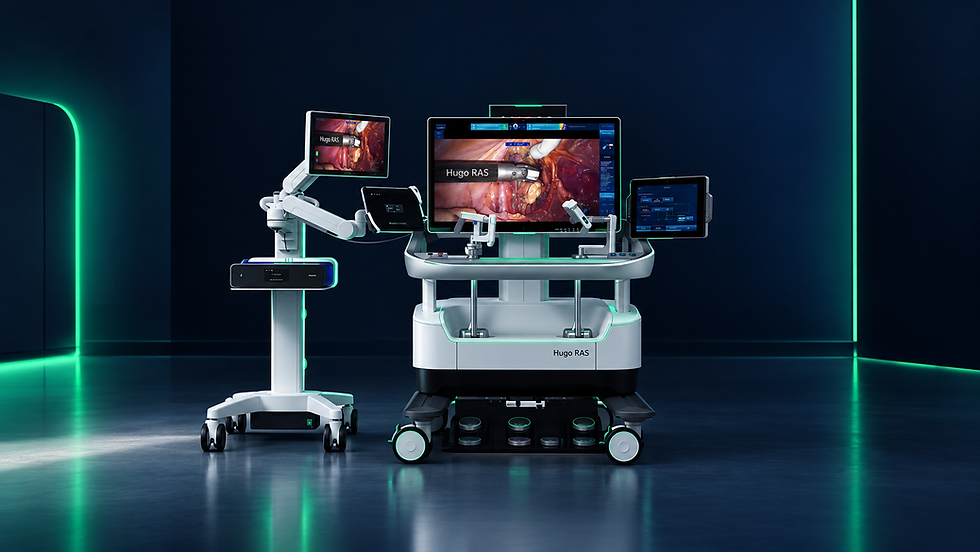
In robotic surgery, the surgeon controls instruments through a camera view. An instrument positioned outside that field cannot be directly monitored.
Medtronic’s new Touch Surgery Aide platform addresses that specific problem with an application called Instrument Exit Point (IEP).
What it does
IEP uses computer vision to detect when an instrument on the Hugo robotic system moves outside the visible camera field.
When that happens, the system can alert the surgical team.
The application is FDA-cleared and is currently used within Hugo’s urologic indications.
Touch Surgery Aide runs on NVIDIA’s Holoscan, CUDA, and TensorRT technologies and is designed to process surgical video and other procedural data in real time.
Why start with this?
IEP does not make a surgical decision.
It does not interpret tissue, recommend a maneuver, or control the robot. It identifies a condition that the surgeon cannot directly observe because the instrument is outside the camera view.
That makes it a relatively narrow AI application with a clear clinical function: monitoring instrument position beyond the visible field.
For surgical AI, this is an important distinction. The system is adding information to the surgeon's view rather than replacing surgical judgment.
The platform matters more than the first application
IEP is one application within Touch Surgery Aide.
Medtronic describes the platform as infrastructure for running multiple AI applications simultaneously, with potential applications across preoperative planning, intraoperative tele-mentoring, and postoperative case review.
The longer-term question is therefore how many clinically useful applications can run reliably on the same infrastructure.
What needs to be demonstrated
The key issue is performance during real procedures.
An alerting system has to detect relevant events reliably while avoiding excessive false alarms. If alerts become frequent or irrelevant, they risk being ignored.
IEP is therefore less interesting as a demonstration of autonomous surgery than as an example of a different direction for surgical AI:
using computer vision to monitor aspects of the operation that are outside the surgeon's immediate field of view.
Source: Medtronic


