Computer Vision in the OR: How AI Sees During Surgery
Updated: Sep 21
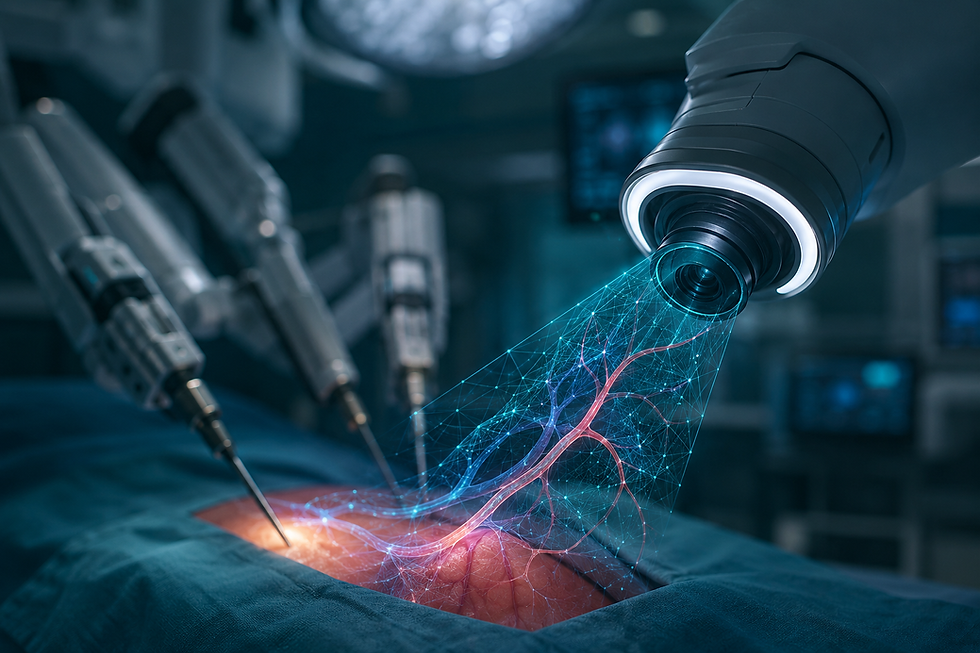
A surgeon's eyes are good. They are not infinite.
An instrument tip can drift past the edge of the camera's view and come back before anyone notices. A tumor margin can look clean under white light and still hide malignant cells a millimeter away. A case can shift phases faster than anyone tracks it in real time.
Computer vision does not replace the surgeon's eyes. It adds a second set. One that never blinks and never tires near hour six.
Watching what the surgeon can't
Medtronic's Instrument Exit Point application runs on its Touch Surgery Aide platform, built for the Hugo robotic-assisted system. It watches the surgical field constantly. When an instrument tip moves outside the visible frame, it flags it immediately.
The FDA cleared it in 2026 as the first real-time AI application built for Hugo.
That sounds small. It isn't. An instrument moving outside the field of view is a known contributor to inadvertent tissue injury in laparoscopic and robotic cases. A silent, constant watcher closes that gap.
Reading tissue the eye can't
Vision doesn't stop at instruments. It reads tissue.
Perimeter Medical Imaging AI's Claire, an AI-enabled wide-field optical coherence tomography system, won FDA premarket approval for use in breast-conserving surgery in 2026. It scans the excised specimen's surface and flags areas suspicious for residual cancer, in real time, in the room.
In its pivotal trial, Claire reached 88.1% margin accuracy and produced a statistically significant drop in residual cancer after surgery compared to standard practice alone.
This is the surgeon's decision, made sharper. A second set of eyes on tissue where a millimeter separates a clean margin from a second operation.
Recognizing where the case stands
Computer vision can also track where a procedure is. Phase by phase, instrument by instrument, structure by structure, without anyone calling it out loud.
A 2025 systematic review of 21 studies on exactly this question found deep learning models recognizing surgical phase with 81% to 93.2% accuracy. Anatomical structure recognition ranged from 71.4% to 98.1%.
Wide ranges. Real numbers. The technology isn't finished, but it already works well enough to matter.
What this is, and what it isn't
None of this is autonomy. The instrument tracker notifies; it doesn't move anything. The margin system flags; the surgeon decides. Phase recognition informs; it doesn't operate.
That's the honest state of computer vision in the OR today: augmented sight, not independent judgment. The surgeon still holds the instrument, still makes the call, still owns the outcome.
But a second set of eyes, built from thousands of hours of surgical video and pattern recognition no single surgeon could hold in memory, changes what "seeing clearly" means in an operating room.
That shift is already underway.


