Humanoid Robots Just Performed Laparoscopic Surgery
Updated: 22 hours ago
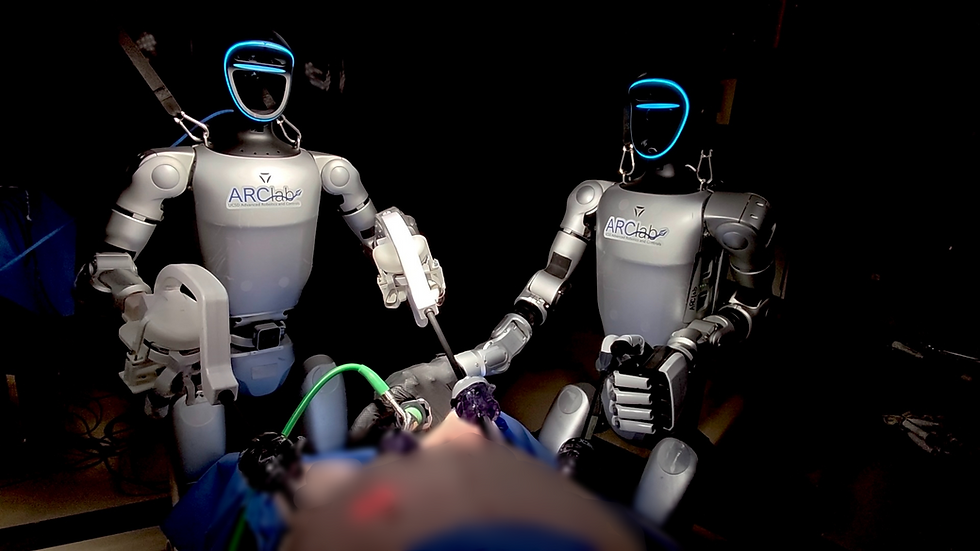
Surgical robots have traditionally been purpose-built machines: fixed platforms, dedicated instruments, and robotic arms designed specifically for the operating room.
UC San Diego researchers are testing a different approach: putting surgical capabilities into a humanoid robot.
In a study published in Nature on July 8, 2026, the team evaluated a humanoid platform called LapSurgie through laboratory testing and live porcine surgery.
What happened
The researchers used teleoperated humanoid robots to perform laparoscopic cholecystectomies in pigs.
In one procedure, a humanoid robot worked alongside a human surgeon. In another, two humanoid robots performed the procedure together, without human hands directly manipulating the instruments.
The study was a preclinical feasibility study, not a human clinical trial. The researchers compared the humanoid system with established surgical platforms through technical testing, user studies, and in vivo procedures.
The robot was designed around a humanoid form factor and could manipulate standard laparoscopic instruments rather than relying entirely on a proprietary surgical platform.
Why the humanoid approach matters
The goal is not simply to make another surgical robot.
A conventional surgical robot is optimized for surgery and built around a fixed operating-room setup. A humanoid robot could potentially perform multiple physical tasks in the same environment, including moving through the room, handling equipment, and manipulating surgical instruments.
That flexibility could eventually make robotic systems easier to deploy across different environments.
It also creates a potential platform for surgery outside highly specialized robotic operating rooms, although that application remains speculative at this stage.
What still needs to be solved
LapSurgie is far from clinical deployment.
The study identified challenges involving control, calibration, manipulation and teleoperation. The procedures were also performed in pigs, so human clinical use would require substantially more validation.
The key question is no longer whether a humanoid can physically perform surgical movements.
It is whether it can perform them reliably, repeatedly and safely enough for clinical use.
What's next
The researchers' work points toward a broader role for humanoid robots in surgery.
A platform capable of moving through a human environment, manipulating surgical instruments, and responding to teleoperation could eventually serve as a physical platform for increasingly autonomous surgical systems.
For now, LapSurgie is a feasibility study.
But it demonstrates a significant shift in surgical robotics: the next surgical robot may be designed less like a surgical machine and more like a general-purpose robot.
Sources:


